
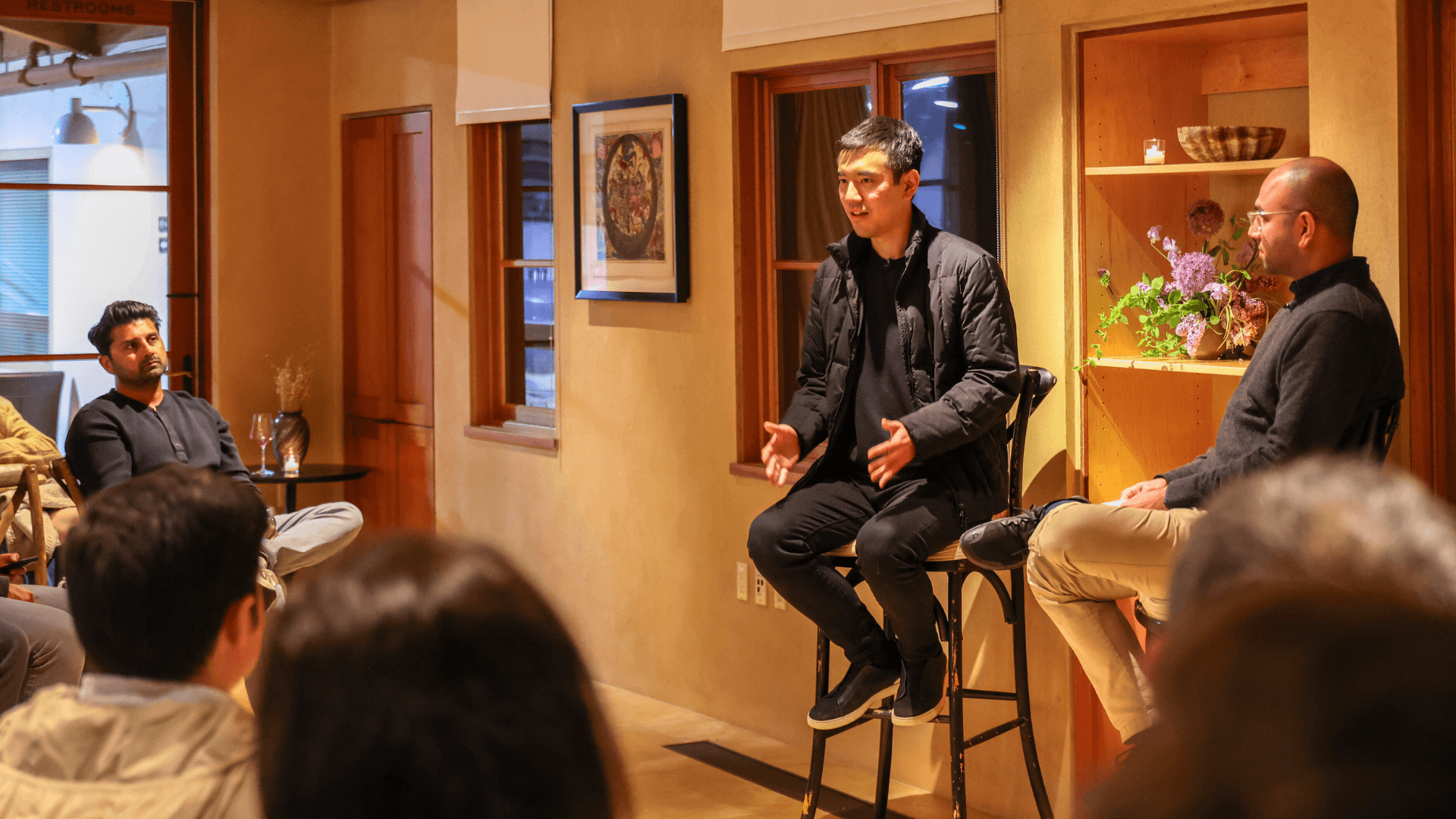
At our 2025 Top Gun retreat, Goodwater’s annual gathering for CEOs, we invited Stanley Tang, DoorDash’s Co-Founder and Head of DoorDash Labs, to share what it really takes to build a generational consumer business. DoorDash started as a Stanford class project in 2013 and today is a $100+ billion market cap public company serving over 500,000 merchants, 42M MAU, and 8M Dashers. Those headline figures are impressive, but Stanley quickly pointed out that greatness comes from the moments when everything seems to fall apart.
Below are five lessons we took away from his fireside chat. For a deeper dive on DoorDash’s business model and S-1, read our “Understanding DoorDash: Dashing to an IPO” post.
1. Start with customers, not solutions
Before writing a single line of code, the DoorDash founders spent months interviewing hundreds of small business owners in Palo Alto. One owner showed them a thick binder of unfulfilled delivery requests, which revealed that local businesses were desperate for help reaching customers. Instead of overengineering, they built a simple two-hour HTML site listing eight restaurant menus with a Google Voice number. When the first customer called for Thai food, the team grabbed a Square card reader and delivered the order themselves. That first market, which Stanley thought might max out at 200 orders per day, now processes more than 6,000–7,000 orders daily.
“Sometimes the best strategy is to start serving customers before you're ready.”
Stanley Tang, Co-Founder, DoorDash
2. Your worst moments define your values
On a rainy September night in 2013, DoorDash’s basic website promised 45-minute delivery for every order during a Stanford football game, and volume exploded. They lacked drivers and capacity controls; every order was hours late, and furious customers were emailing nonstop. With three weeks of runway left, the founders faced a choice: send apology emails to preserve cash or fully refund every order, burning roughly 40% of their remaining money. They made the call in about 15 seconds to refund, spent the night baking cookies, and hand-delivered them with handwritten apology notes. That crisis forged DoorDash’s core value of “customer obsession.”
“It’s really these moments where your values are created. It’s not what you just write on a PowerPoint slide.”
Stanley Tang, Co-Founder, DoorDash
3. Constraints drive innovation better than capital
By 2016, Uber had entered food delivery with $3 billion at its disposal. DoorDash, with about $100 million, knew it couldn’t outspend competitors. Lean resources forced the team to obsess over operational excellence: they improved dispatch algorithms, measured unit economics down to the second, and made hundreds of small process changes. That discipline paid off. When SoftBank invested in 2018, internal retention and cost data convinced SoftBank to proceed even after doubts emerged. Stanley believes that if the money had come sooner, it would’ve been wasted because the constraints forced excellence that abundance never could.
“That was when DoorDash became operationally excellent, because we didn't have the money to just subsidize. We had to build a better business.”
Stanley Tang, Co-Founder, DoorDash
4. Hire for cultural DNA, not just skills
DoorDash’s early interview process was deliberately unconventional: candidates were asked to spend eight hours acquiring 100 new customers in the real world. Half quit immediately, a third lasted two hours, and no one ever hit the target. The goal wasn’t to reach 100 but to see who would embrace the grind and maintain standards under pressure. In Stanley’s words, DoorDash is “a low-margin logistics, operational grindy business.” The interview filtered for people obsessed with execution, culture carriers who later scaled the company to more than 23,000 employees across 30 countries.
5. Build to disrupt yourself
Even at a $100 billion market cap, Stanley spends his time thinking about how to disrupt DoorDash. He believes the next evolution of local commerce won’t look like a slightly better food delivery app but will harness emerging technologies like AI, autonomy, or drones. DoorDash is already embedding AI across the company: employees use AI-assisted coding tools, and restaurant onboarding has been transformed from a two-week manual process to instant menu digitization using large language models. The team also reimagines products that didn’t work the first time. “DoorDash Flash,” an early attempt at batched delivery, failed. Five years later, it returned as “Double Dash,” offering cross-category orders after checkout and becoming a meaningful growth opportunity.
“The next DoorDash most likely is going to come along not because they built a slightly better DoorDash, but it’s because of things like AI, autonomous [vehicles], drones.”
Stanley Tang, Co-Founder, DoorDash
The pursuit of greatness
Stanley’s parting thought was that DoorDash is still “at the very, very beginning.” Greatness is not a destination; it’s the relentless pursuit of better. As consumer investors, we look for founders who share that mindset, leaders who obsess over customers, build values through hard decisions, operate with discipline, hire cultural stewards, and embrace reinvention. Those companies will define the next decade of consumer tech.
“Companies don’t start out great. Greatness is developed over time.”
Stanley Tang, Co-Founder, DoorDash
For more insights on building category-defining companies, explore Goodwater Perspectives.